When comparing dentures vs. dental implants, dentures usually cost less upfront and avoid implant surgery, while dental implants often provide better stability, stronger chewing, and better jawbone preservation. The better choice depends on how many teeth are missing, the condition of your gums and bone, your medical history, your budget, and whether you want a removable or more fixed-feeling solution.
Both options can restore appearance and function, but neither is automatically the best fit for every patient. A dentist or prosthodontist can examine your mouth, review your goals, and explain the likely benefits, limits, and long-term maintenance of each approach.
Exploring dental implants can clarify whether an implant-based solution fits your needs. Wagner Sleep Dental in Indianapolis, IN can explain the likely treatment pathway, expected recovery, and what to expect at each step.
Dentures are removable appliances that replace several teeth or a full arch of teeth. They rest on the gums, and upper dentures may also cover part of the roof of the mouth.
Partial dentures replace some missing teeth and usually connect to remaining teeth with clasps or other attachments. Full dentures replace all teeth in the upper jaw, lower jaw, or both.
Dental implants are small posts, usually titanium, placed into the jawbone. As the bone heals around them through osseointegration, the implants can support a crown, bridge, or full-arch restoration.
A third option combines both approaches. An implant-supported denture attaches to implants for better stability and may be removable by the patient or fixed for removal only by a dental professional.
Consideration | Traditional Dentures | Dental Implants | Implant-Supported Dentures |
|---|---|---|---|
Stability | May shift during chewing or speaking | Fixed and usually feels most like natural teeth | More stable than conventional dentures |
Surgery | Usually not required once the mouth is ready | Requires implant placement | Requires placement of several implants |
Treatment time | Often shorter | Commonly takes several months | Commonly takes several months |
Bone preservation | Does not stop normal bone loss after tooth loss | Helps maintain bone around functioning implants | Helps maintain bone around the implants |
Cleaning | Removed and cleaned daily | Brushed and cleaned around the gumline | Depends on whether the prosthesis is removable or fixed |
Initial cost | Usually lower | Usually higher | Often between dentures and full implant treatment, depending on design |
Longevity | May need relining, repair, or replacement as the mouth changes | Implants can last many years, though restorations may need maintenance | Attachments and prosthetic teeth may wear and need service |
Costs vary based on the number of missing teeth, materials, imaging, preparatory care, sedation, and insurance benefits. A written treatment plan should separate surgical, restorative, laboratory, and follow-up costs so the comparison is easier to understand.
The evaluation starts with your symptoms, dental history, medical conditions, medications, tobacco or nicotine use, and goals for comfort, appearance, and chewing. The dentist also checks your gums, remaining teeth, bite, jaw movement, available space, and ability to keep the restoration clean.
Dental X-rays help show teeth and bone levels. Before implant treatment, three-dimensional cone-beam computed tomography, or CBCT, may be recommended to measure bone and locate nerves and sinus spaces.
Some conditions can affect healing or long-term success. These include active gum disease, untreated decay, poorly controlled diabetes, significant dry mouth, heavy grinding, and nicotine use.
These issues do not always rule out treatment, but they may need to be managed first. Improving gum health with periodontal hygiene can support healing and long-term results for either option.
Bone loss after tooth loss can reduce the amount of space available for implants. In some cases, bone grafting or sinus augmentation may be considered, although not every patient wants or is medically suited for added procedures.
Traditional dentures may be the more practical option when many or all teeth are missing, surgery is not preferred, bone volume is limited, or lower upfront cost matters most. They can also restore appearance and basic function relatively quickly after extractions.
Immediate dentures may sometimes be placed the same day teeth are removed. Because the gums and bone change during healing, these dentures often need adjustments, a reline, or eventual replacement.
Most patients need time to adapt to removable dentures. Early changes can include more saliva, mild sore spots, altered speech, and less chewing efficiency, especially with hard, sticky, or fibrous foods.
Even a well-fitting denture may loosen as the jaw changes over time. Adhesive may help in some cases, but repeated sores or ongoing movement should be evaluated instead of managed indefinitely at home.
Implants may be a better fit for patients who want more stable chewing, a restoration that does not rest fully on the gums, and support for preserving jawbone. A single implant can replace one tooth without relying on neighboring teeth, while multiple implants can support a bridge or full arch.
Implants still require healthy surrounding tissues and consistent home care. Although an implant cannot get a cavity, plaque can still cause inflammation and progressive bone loss around it, called peri-implant disease.
Implant treatment is not instant, and it is not risk-free. Healing often takes several months, and possible complications include infection, failure to integrate with bone, damage to nearby structures, gum recession, loosening parts, or fracture of prosthetic teeth.
Some patients receive a temporary tooth or temporary arch soon after implant placement. That approach is not right for every case and depends on bone quality, implant stability, bite forces, and the overall treatment design.
An implant-supported denture can reduce rocking and improve chewing compared with a conventional denture. This can be especially helpful in the lower jaw, where traditional dentures often have less natural suction and stability.
Removable versions snap onto attachments and must be taken out for cleaning. Fixed full-arch restorations stay in the mouth, but the area underneath still needs careful cleaning with tools recommended by the dental team.
Maintenance visits remain necessary even when the restoration feels secure. Attachments, clips, screws, and prosthetic teeth can wear over time and may need service.
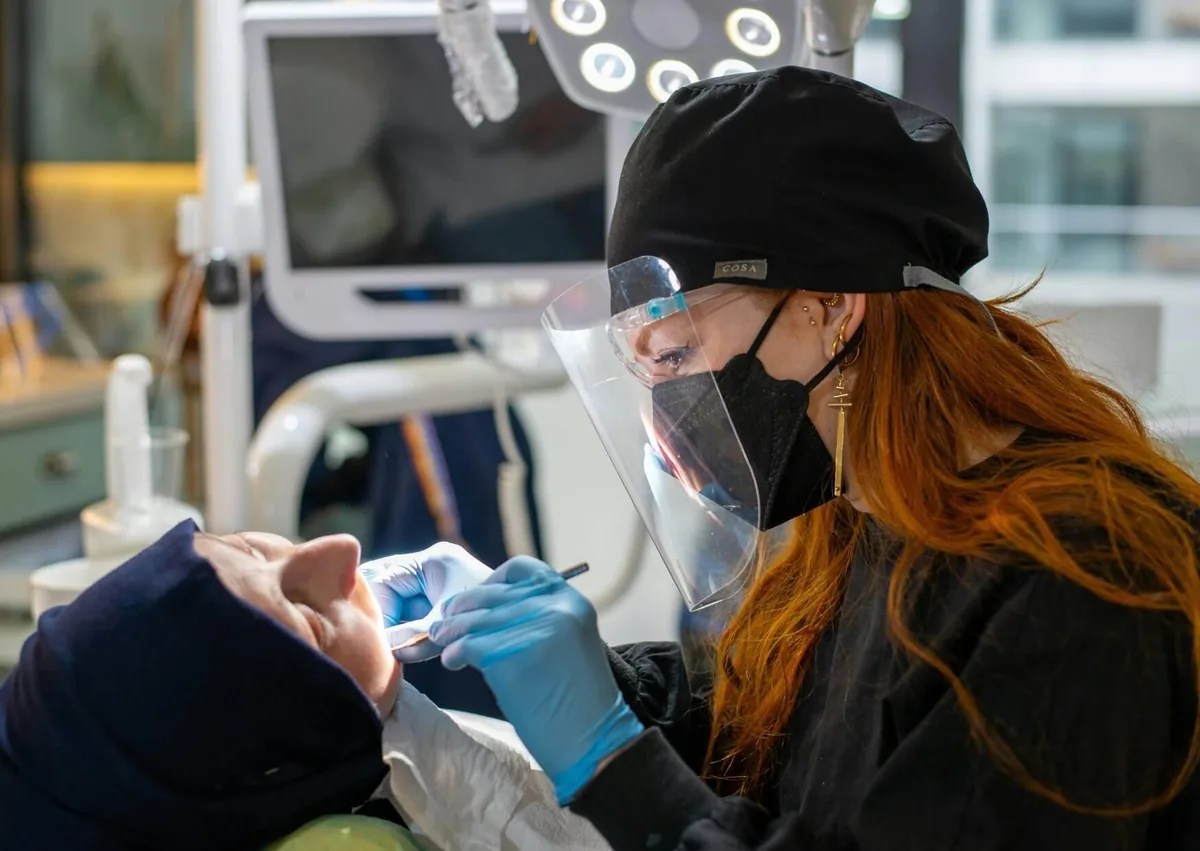
Dentures usually involve impressions or digital scans, bite records, try-in visits, and delivery. If tooth extractions are needed, see tooth extraction time for details; gum tenderness and fit changes are expected during healing, and adjustment visits are common.
Implant treatment begins with planning and any needed care for infection, gum disease, or inadequate bone. After placement, implants may heal for several weeks to months before the final restoration is attached, although timing varies by location and case complexity.
After oral surgery, temporary swelling, bruising, minor bleeding, and soreness can occur. Follow the treating clinician's instructions for diet, cleaning, activity, and medications rather than relying on a generic recovery plan.
Contact the dental office promptly if pain or swelling gets worse after first improving, bleeding continues, fever develops, pus appears, a bad taste comes with increasing tenderness, numbness is new, an implant part becomes exposed, or a restoration feels loose. Seek urgent medical care for difficulty breathing or swallowing, rapidly spreading facial or neck swelling, or uncontrolled bleeding.
Conventional dentures should be removed and cleaned as directed. The gums, tongue, and any remaining teeth should also be cleaned daily with appropriate products.
Dentures usually should not be worn overnight unless a dentist gives specific instructions. Tissues need rest, and continuous wear may increase irritation or infection risk.
Implants and implant-supported restorations require daily plaque removal at the gumline and around or under the prosthesis. A dentist or hygienist may recommend floss threaders, interdental brushes, or water-flossing devices based on the design.
Regular exams help catch gum inflammation, bite changes, worn parts, fractures, and oral lesions early. Even patients without natural teeth still need professional oral examinations.
Arrange an evaluation for persistent sores, unexplained bleeding, a lump, or a red or white patch that lasts longer than two weeks. Those symptoms deserve prompt attention whether you wear dentures, have implants, or use both.
The best decision usually comes from looking at the full treatment path, not just the first procedure. Comparing function, healing, maintenance, replacement costs, and health factors with a dental professional can help you choose an option that is realistic and sustainable.
To confirm whether implants are a realistic option for your mouth, arrange a focused consultation including imaging and treatment planning so you leave with clear options. Wagner Sleep Dental offers dentures and dental implant consultations in Indianapolis, IN and nearby Greenwood, IN; call (317) 881-4000 or schedule online to make an appointment.
No. Implants often provide better stability and bone support, but dentures may be the better choice when surgery, healing time, health factors, or upfront cost make implants less practical.
Sometimes. The existing denture, available bone, bite, and planned implant positions help determine whether a current appliance can be modified or whether a new one is needed.
Dentures often need relining, repair, or replacement as the mouth changes and materials wear. Implants can function for many years, but crowns, bridges, attachments, or full-arch restorations may still need maintenance or replacement.
Coverage varies by plan. Some policies help pay for dentures or the restoration attached to implants but exclude implant surgery, grafting, imaging, or replacement parts, so ask for a written estimate and verify benefits directly with the insurer.
Possibly. Mild to moderate bone loss may sometimes be managed with implant positioning, a different restoration design, or grafting, but severe bone loss can limit options and requires an exam with appropriate imaging.
Fixed implant restorations usually provide stronger and more stable chewing than conventional dentures. Results still depend on the restoration design, bite, muscle control, food choices, and the health of the supporting tissues.
Always great to see the beautiful staff at Dr Susan Wagner’s office. Always a pleasant experience when I visit for any procedure. I highly recommend Dr Susan if... read more

 celine masterson
I am so glad to see my dentist and Jennifer the hygenist! My name happens to be identical with the dentist, but I am just a patient! Jennifer... read more
 Susan Wagner
The kindest group of ladies you’ll ever find from reception to dentist. I hadn’t been to the dentist in about 5 years (due to fear among other things). I finally... read more
 Hayden Phillips
I love going to this dental office. Dr. Wagner and her staff are very caring. They do a great job and explain the procedures well.
 Amy Studebaker
We’re kind and personable yet professional! Took time with me to explain what I needed done.
 Patricia Duncan
Actually, today was one of the best cleanings I have ever had. Would love to have Linda everytime.
 Linda Clark
This is my 4th cleaning day. I have never looked forward to getting dental work done but this is a very professional, friendly efficient practice. Now I look... read more
 Susan Fillmer
Called in the morning and seen the same day for a lose crown. Dr. Wagner has always taken great care of our family dental needs!
 Kevin Gregory
I appreciate the professional service and friendly staff. Always quick to respond to any issues I may have. Highly recommend! Terry T.
 Terry Thompson
Success stories that speak for themselves