Full mouth dental implants typically cost about $30,000 to $90,000 or more for both arches in the United States. Your actual price depends on the type of restoration, the number of implants, bone and gum health, preparatory procedures, materials, anesthesia, and local fees, so a personal exam and written estimate are the only reliable way to know your cost.
In most cases, “full mouth” does not mean one implant for every missing tooth. Treatment usually uses several implants to support a fixed bridge or a removable denture for the upper arch, lower arch, or both.
If you’re deciding whether full-arch replacement or improved denture stability fits your needs, learning about dental implants clarifies realistic options and tradeoffs. Wagner Sleep Dental in Indianapolis, IN explains likely timelines, typical steps, and how treatment could affect comfort and chewing.
A full estimate may include diagnostic imaging, tooth extractions, information on typical tooth extraction time, implant placement, sedation dentistry or anesthesia, temporary teeth, lab work, the final prosthesis, and follow-up visits. Some advertised prices cover only surgery or only one arch, while others bundle most phases of care.
Treatment is often completed in stages. After planning, the implants are placed, the bone heals around them, and the final teeth are attached once the implants are stable.
“Same-day teeth” usually means a temporary fixed restoration is placed near the time of surgery. It does not mean healing is complete or that the final prosthesis is delivered that day.
The number and position of implants strongly affect cost. A fixed full-arch bridge often uses four to six implants per arch, although anatomy and bite forces may require a different design; the All-on-4® treatment concept is one well-known example of a fixed full-arch approach.
Bone grafting or sinus augmentation may be needed if the jaw does not have enough healthy bone to support implants. Active gum disease, including problems discussed in how to fix gingivitis, infected teeth, complex extractions, and bite correction can all add time, visits, and cost.
Materials also matter. Acrylic or composite teeth on a metal framework often cost less than zirconia, while zirconia may offer different strength, appearance, repair, and maintenance tradeoffs.
Fees also vary by clinician experience, laboratory quality, imaging technology, anesthesia needs, and local operating costs. A lower quote is not automatically worse, but it should be compared by what is included, not by price alone.
The evaluation starts with your medical and dental history, an oral exam, and imaging. A cone-beam computed tomography scan, or CBCT, gives a three-dimensional view of bone volume, nerves, sinuses, and possible implant positions.
The dentist also checks gum health, remaining teeth, jaw relationship, smile line, speech, and the space available for replacement teeth. Digital scans or impressions may be used to plan the bite and decide whether fixed or removable teeth are more appropriate.
Your health history can affect timing and risk. Poorly controlled diabetes, tobacco or nicotine use, certain bone-related medications, immune conditions, and prior head or neck radiation all require careful review, but they do not always rule out implants.
Complex cases may involve a general dentist, prosthodontist, oral and maxillofacial surgeon, or periodontist. Ask who will perform each stage and who will handle long-term maintenance and repairs.
Several treatments can restore a full arch. Their upfront cost, stability, cleaning needs, repair demands, and long-term maintenance are different.
Option | How It Is Supported | Typical Considerations |
|---|---|---|
Conventional denture | Rests on gums | Usually the lowest initial cost; removable and may move during chewing |
Implant-retained overdenture | Clips onto implants | Removable; better retention, but attachments need maintenance |
Fixed implant bridge | Secured to several implants | Not removed by the patient; higher initial cost and requires careful cleaning underneath |
Individual implant crowns | Separate crowns on separate implants | Rarely practical for a full arch; may require many implants and much higher cost |
A removable implant overdenture may use fewer implants and can be easier to clean. However, clips and related parts wear over time and may need replacement.
A fixed bridge can feel more like natural teeth because it is more stable during function. Even so, it still needs specialized home care and regular professional maintenance.
Conventional dentures are still appropriate for some patients because they avoid implant surgery and usually cost less at first. They do not stop all jawbone changes, and they may need relining or replacement as the mouth changes.
Ask for a written estimate that separates the upper and lower arches and clearly lists temporary and final restorations. It should identify the planned number of implants, restoration material, grafting or extractions, anesthesia, imaging, lab fees, and follow-up care.
Also ask what happens if an implant does not integrate or if temporary teeth break. Warranty terms may have exclusions, and routine maintenance, night guards, repairs, replacement parts, and future prosthesis replacement may not be included.
Dental insurance may help with exams, imaging, extractions, dentures, or part of the restoration, but annual maximums and exclusions often limit coverage. Medical insurance may sometimes apply after qualifying trauma, disease, or surgery, but coverage is plan-specific.
Financing can spread out payments, but it does not lower the total treatment cost. Review interest rates, deferred-interest terms, refund policies, and who pays for changes discovered during surgery before signing an agreement.
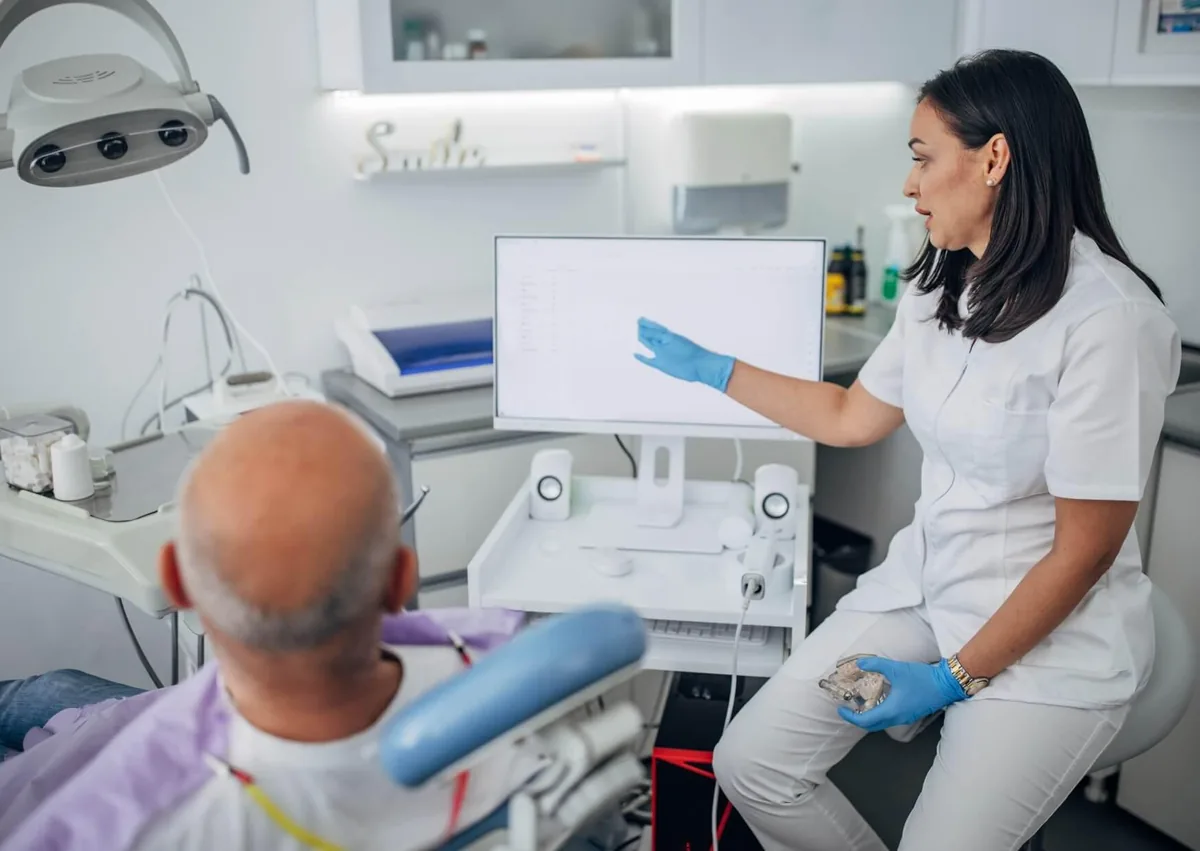
Full treatment often takes several months, especially if extraction sites or grafts need to heal before implant placement. Some patients can receive implants and temporary fixed teeth in one visit, but immediate loading depends on bone quality, implant stability, and bite control.
Swelling, bruising, soreness, and minor bleeding are common after surgery and usually improve over the first several days. Follow your treating clinician’s instructions for hygiene, diet, activity, and medications rather than relying on a general online timeline.
The implants then need time to join with the surrounding bone through osseointegration. Temporary teeth may need adjustments during healing, and the final restoration is usually made after the tissues and implant positions are stable.
Implants cannot get cavities, but the surrounding gums and bone can still become inflamed or infected. Daily cleaning around and beneath the restoration, regular professional care, and avoiding tobacco or nicotine can reduce preventable complications.
Your dental team may recommend floss threaders, interdental brushes, a water flosser, or other cleaning tools based on the design of your restoration. Patients who clench or grind may also need a night guard to reduce excess force.
Regular professional periodontal hygiene can help control gum disease before and after implant placement and may reduce the risk of long-term bone loss.
Maintenance visits let the team check the gums, bite, screws, attachments, and prosthesis. Report persistent bleeding, bad taste, increasing spaces, loosening, or a bite change instead of waiting for the next routine visit.
Seek prompt dental care for worsening pain, swelling, pus, fever, uncontrolled bleeding, an implant or bridge that moves, or numbness that persists or develops after surgery. Trouble breathing or swallowing, rapidly spreading facial or neck swelling, or severe uncontrolled bleeding requires emergency care.
A thorough exam and a clearly itemized plan are the best way to compare full mouth implant costs. The goal is not just the lowest starting quote, but a treatment design that fits your oral health, medical risk, functional needs, ability to maintain the restoration, and long-term budget.
To get an itemized estimate and personalized plan for full-mouth care, arrange an implant consultation to review costs, options, and preparatory needs. Call Wagner Sleep Dental, specialists in dental implants in Indianapolis, IN and Greenwood, IN, at (317) 881-4000 to schedule an appointment.
Many advertised prices apply to one arch only, meaning either the upper or lower jaw. Confirm whether the figure includes both arches, temporary teeth, final teeth, surgery, anesthesia, imaging, extractions, grafting, and follow-up care.
A fixed restoration often uses four to six implants per arch, but there is no universal number. Bone anatomy, bite forces, prosthesis design, health history, and implant position all affect the final plan.
Coverage varies widely. A plan may help pay for exams, imaging, extractions, dentures, or part of the restoration while excluding implant placement or limiting payment through an annual maximum.
Implants are designed as long-term supports, but no component is guaranteed to last for life. The bridge, denture teeth, screws, clips, or other parts may wear or need repair, and gum or bone disease can still threaten the implants without ongoing care.
In some cases, extractions, implants, and temporary teeth can be completed in one visit. This approach is not right for everyone, and the final teeth are usually delivered only after healing and confirmation that the implants are stable.
I am so glad to see my dentist and Jennifer the hygenist! My name happens to be identical with the dentist, but I am just a patient! Jennifer... read more

 Susan Wagner
Entire team is fabulous! So welcoming and compassionate. Dr W is the BEST!!! Highly skilled at everything she offers!
 Keisa Messer
I have gone here for dental work my whole life at this point, and they have never been rude to me and have always been patient with me when I... read more
 nick lorance
This is my 4th cleaning day. I have never looked forward to getting dental work done but this is a very professional, friendly efficient practice. Now I look... read more
 Susan Fillmer
I have been going to Dr. Wagner for decades. Her staff is all female, which as a person with a small mouth and jaw, I really appreciate the smaller hands.... read more
 Carol Farrington
I hadn't been to the dentist in 10 years and hadn't really smiled for about the same. Dr. Wagner and her staff made me feel comfortable instantly. She is not... read more
 Rachael Manson
Dr. Susan Wagner and her staff are amazing. They are very professional, gentle, efficient and experienced. They are also calm and very kind. I appreciate having such a great experience... read more
 Amy Tomey
Well run office. They are very conscientious in helping individuals maintain healthy teeth.
 Roger Kinsey
Actually, today was one of the best cleanings I have ever had. Would love to have Linda everytime.
 Linda Clark
Success stories that speak for themselves